Dungeons and Daughters: A Simplified D&D Ruleset for Kids
/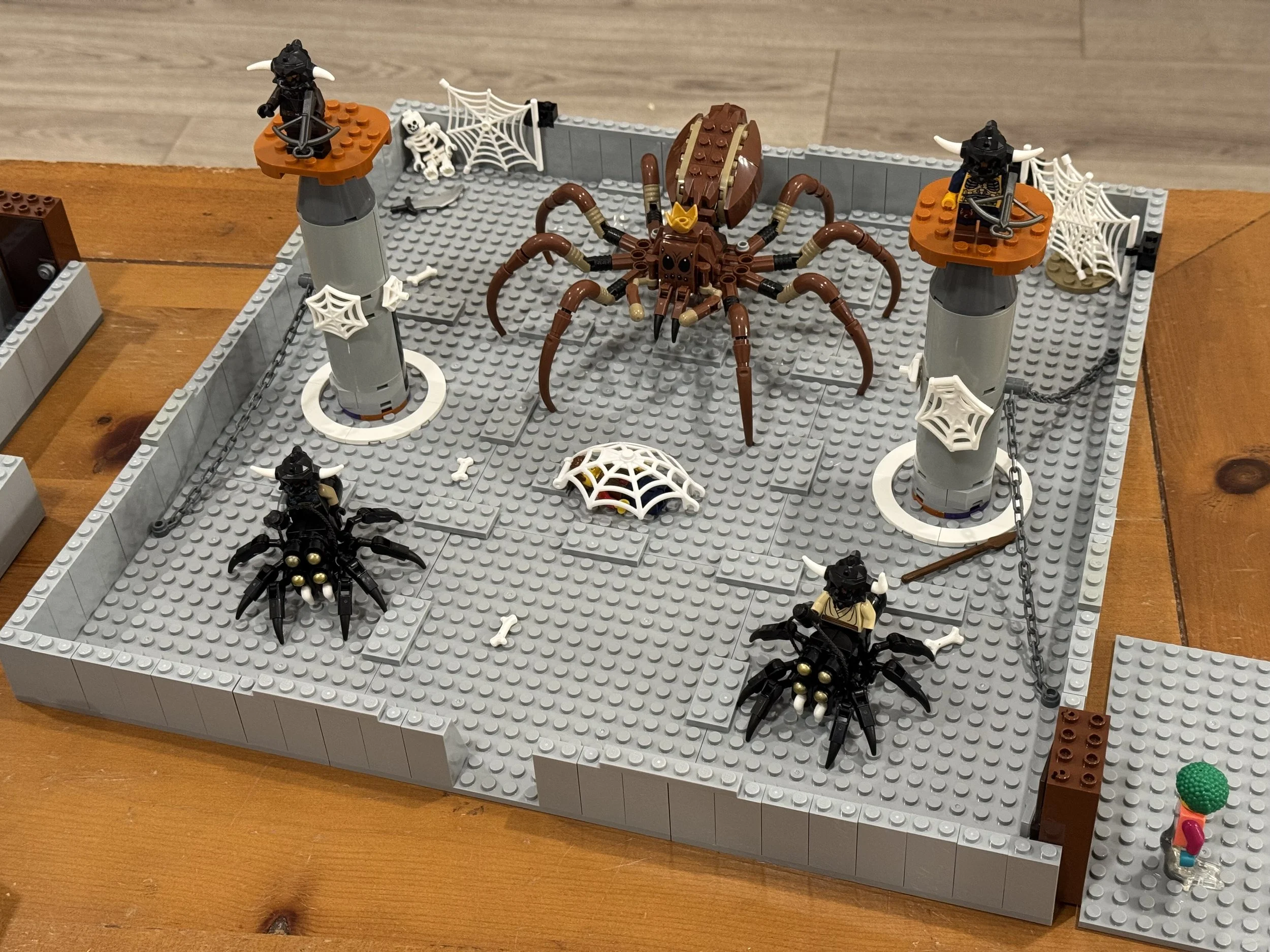
A battle map and enemies made from Lego bricks.
Combat
Combat Dice Ratings
Every combatant has a combat die, which determines how powerful they are in battle. This die is used for both attacking and defending. The higher the maximum value of the die, the more powerful the character.
Most player characters use a D12 as their combat die, as do the strongest enemies they encounter regularly. The D20 is rare and should be reserved for powerful enemies or boss battles.
Examples of monsters that might use each level of combat die.
Combat Dice Scale:
D4 – Puny (small critters, e.g. spiders)
D6 – Pretty Weak
D8 – Considerable Creature/Unskilled Humanoid
D10 – Human-sized Creature/Capable Humanoid
D12 – Fearsome Creature/Skilled Humanoid
D20 – Legendary (bosses, big monsters)
Initiative
At the start of a battle, all participants roll a D20 to determine initiative.
Turn order proceeds from highest to lowest roll.
Movement and Actions
On each turn, a character may perform one movement and one action.
Movement
A character can move up to 16 LEGO studs (about 5 inches).
Movement can be broken up—for example, a character can take half of their movement, take an action, and then use the rest of their movement.
Actions
A character may take one action per turn.
An action can be:
Making a melee or ranged attack
Casting a spell
Using a support action
Taking additional movement (up to 32 studs total if no other action is taken)
Attack Ranges
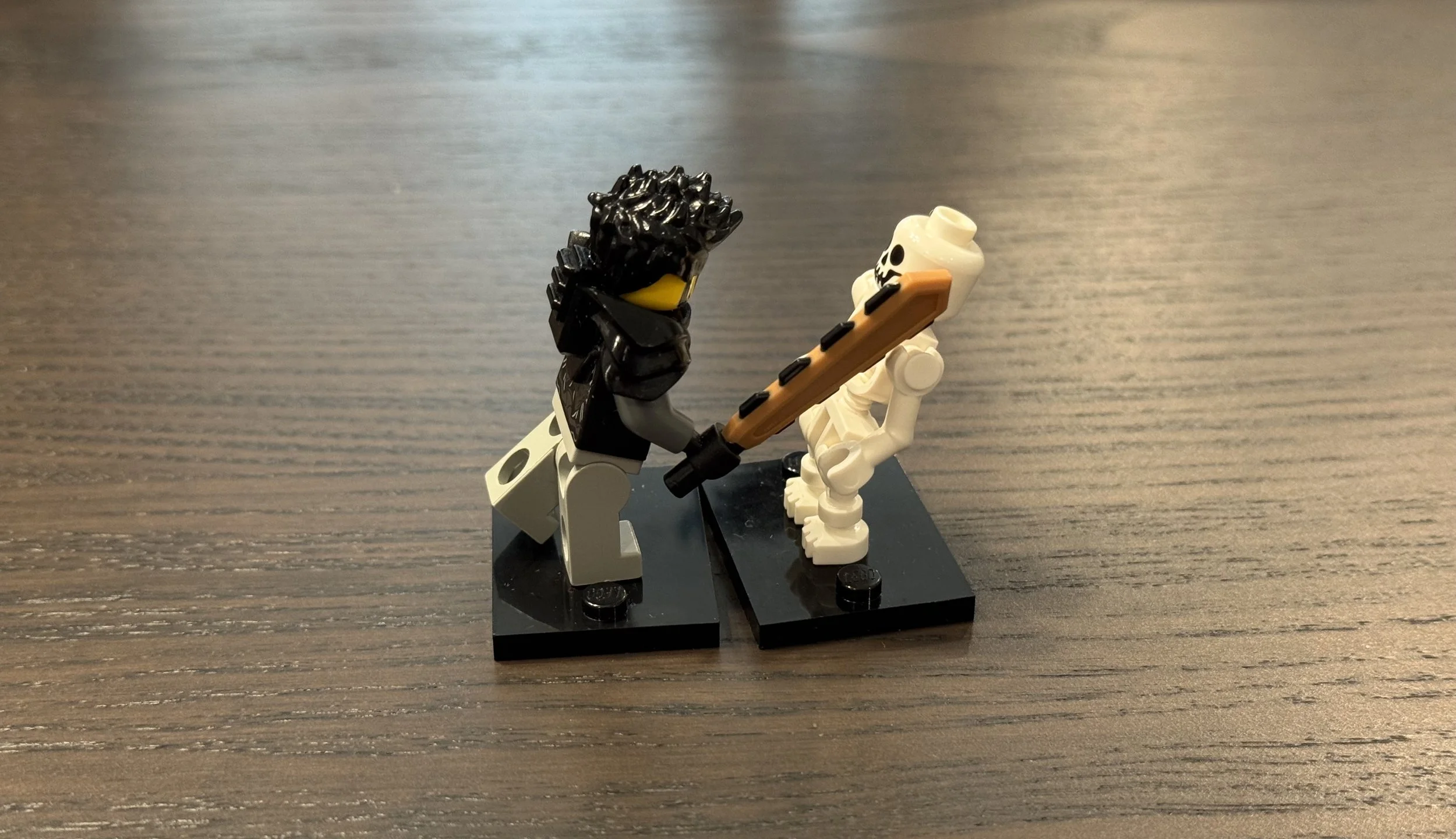
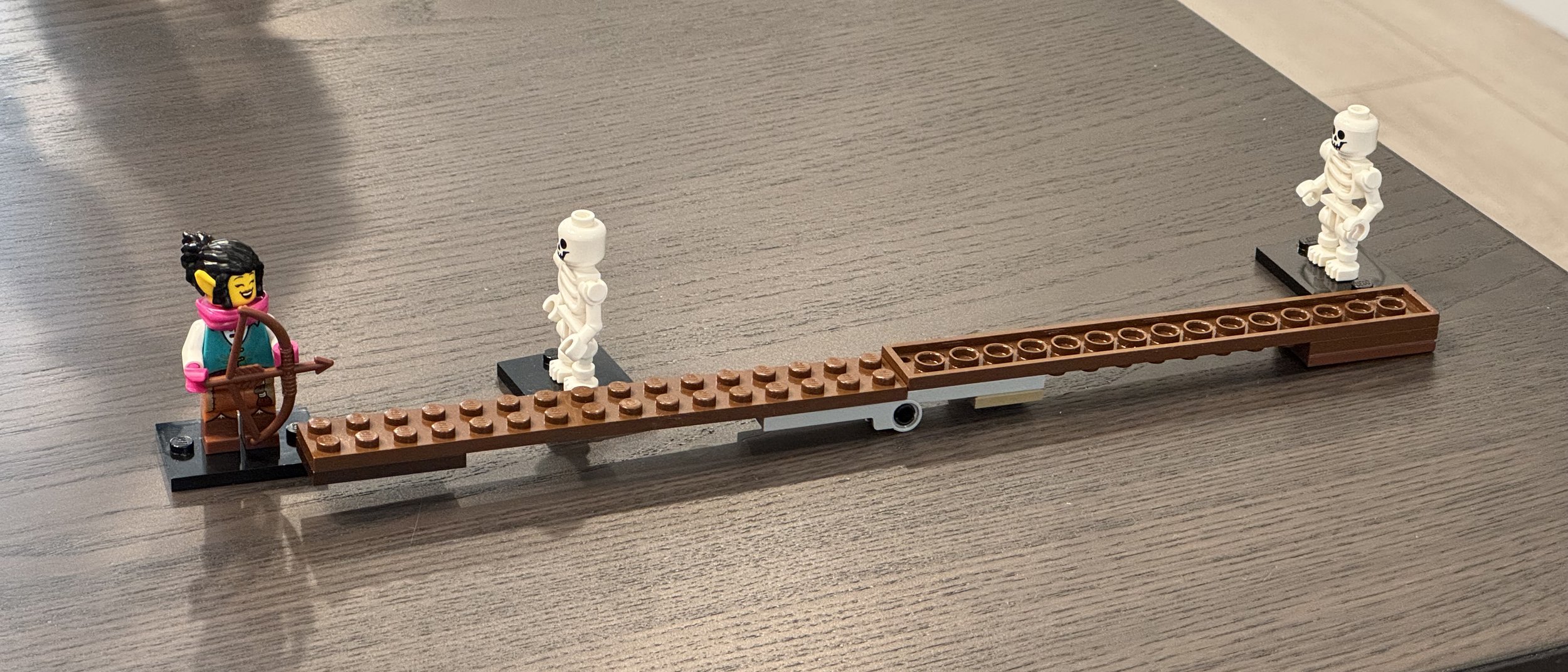
Melee Attacks: Must be made while adjacent to the target.
Ranged Attacks: Can be made from 8–32 studs away.
Ranged attacks from closer than 8 or farther than 32 studs may be attempted, but are rolled with disadvantage.
Resolving Attacks
Initiating Combat: When one character attacks another, both the attacker and the defender roll their combat die.
Comparing Rolls:
If the attacker rolls higher, the defender is hit and loses 1 heart.
If the defender rolls higher, the attack misses—no hearts lost.
If the roll is a tie, the advantage goes to the player character or their ally (“ties go to the good guys”).
Hearts
A player character minifigure next to a health bar made with Lego pieces.
Each character has a number of hearts (typically 3 for players and allies, 1–5 for enemies).
Losing all hearts causes the character to fall unconscious.
Hiding and Stealth
A character may attempt to hide during combat by making a stealth check.
A good roll is generally enough to successfully hide. You don't have to beat an enemy's perception check unless they are actively watching you.
If a character is hidden:
They gain advantage on attacks made from hiding.
Enemies must roll perception checks to try to detect the hidden character. If they fail, they attack with disadvantage.
After making an attack or moving, the character is no longer hidden and must make a new stealth check to hide again.
Advantage and Disadvantage
Advantage: Roll the die twice and take the higher result.
Disadvantage: Roll the die twice and take the lower result.
Rest and Recovery
When a character goes to sleep, they regain all lost hearts upon waking the next morning.
There is no permanent death for player characters or allies.
When a character loses all their hearts, they fall unconscious.
Enemies will stop attacking unconscious characters.
An unconscious character is stable and will not lose additional hearts.
They can be revived by:
A successful medicine check by another character
A healing item such as food or a potion
Resting overnight, which restores all hearts
Support Abilities
Support abilities allow characters to help their friends in battle. These are optional powers that can be chosen at character creation or added through story events.
Examples:
Healing Hug
Use: Once per battle
Effect: Restore 1 heart to an adjacent ally
Flavor: You give them a big hug, say something encouraging, and they feel better!
Inspiration
Use: Once per day
Effect: Give an ally advantage on their next roll (attack or skill)
Flavor: You cheer them on, sing a little song, or do something uplifting to boost their courage.
Skill Checks
Skill checks work similarly to Dungeons & Dragons but with simplified rules.
Players roll a single D20 to attempt a skill check when prompted by the DM. The DM may grant advantage or disadvantage to this roll depending on the circumstances.
Each character may choose one skill to be their Strength (rolled with advantage) and one to be their Weakness (rolled with disadvantage). For example, a burly character in bulky armor might roll Athletics with advantage but Stealth with disadvantage.
Choosing a Strength and Weakness is optional. Without either, all skill checks are made with a single D20 roll.
Interpreting Rolls
Nat 20 (natural 20): Automatic and spectacular success.
15–19: Very good.
10–14: Pretty good.
5–9: Not very good.
2–4: Bad.
Nat 1 (natural 1): Catastrophic and hilarious failure.
Example Skills
These are common skills that characters might roll for, grouped by their associated attribute. However, new skill types can be made up as needed.
Strength
Athletics
Dexterity
Acrobatics
Sleight of Hand
Stealth
Intelligence
Arcana
History
Investigation
Nature
Religion
Wisdom
Animal Handling
Insight
Medicine
Perception
Survival
Charisma
Deception
Intimidation
Performance
Persuasion